Dermal fillers add volume, smooth lines, and restore contour to areas of the face that have lost fullness over time. More than 3 million people in the United States receive filler injections every year, making them one of the most performed nonsurgical cosmetic treatments in the country1. The procedure usually takes under an hour, produces visible results right away, and requires minimal recovery time.
For adults in Fort Lee and Bergen County, NJ, considering fillers for the first time, the questions tend to cluster around a few core concerns: what the substance is, which areas it treats, how it differs from Botox, and whether the results hold up over time. Those questions have straightforward answers. Here’s what the evidence shows.
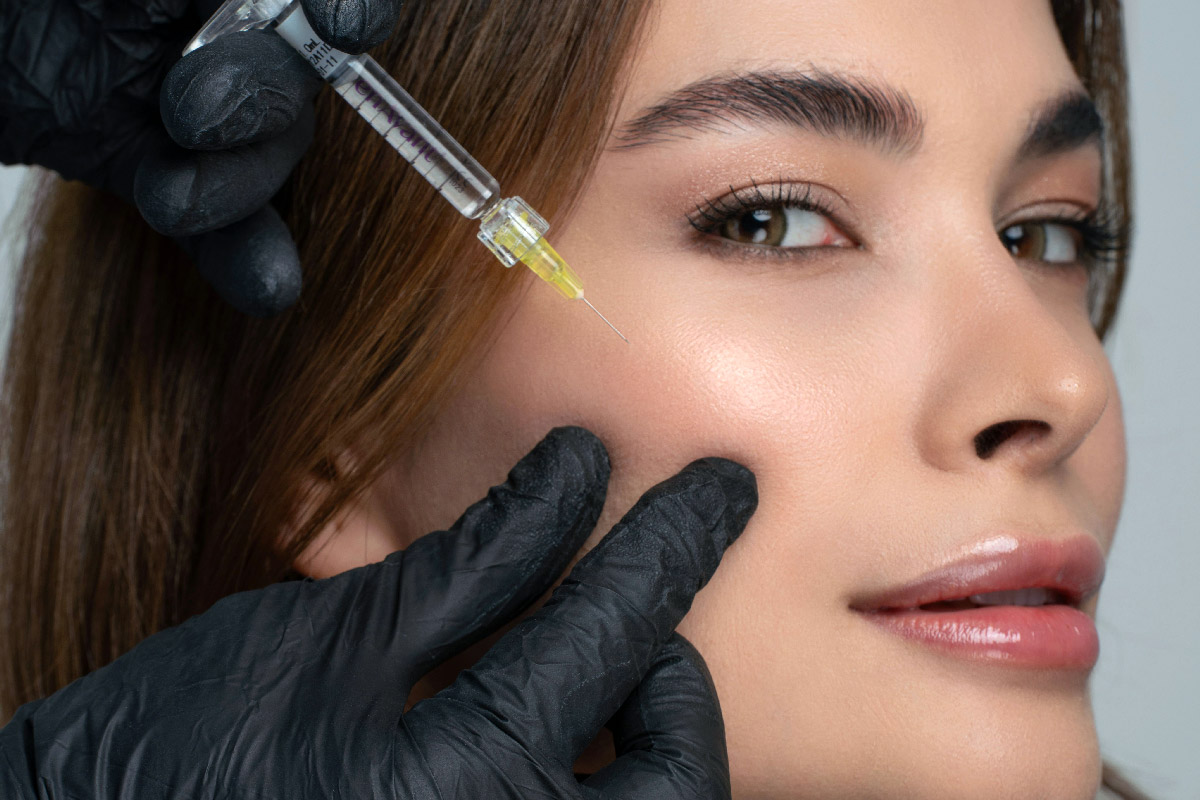
Some may be wondering, “What are fillers?” Dermal fillers are injections placed just beneath the skin’s surface to plump up wrinkles, restore lost volume, and smooth lines that form as collagen naturally decreases with age. The procedure can be described as nonsurgical, office-based, and fast: Most appointments wrap up in under an hour, and patients typically resume normal activity the same day1.
The most widely used category is hyaluronic acid (HA) fillers, a substance the body naturally produces. As HA levels drop with age, skin loses the hydration and plumpness it once held. Injecting HA fillers replenishes that loss directly at the treatment site.
The filler’s composition determines how it behaves, where it’s used, and how long it lasts. The American Society of Plastic Surgeons identifies four primary categories in widespread clinical use2:
Each type carries a different longevity profile and works better in certain areas than others. The provider chooses the filler based on the location it’s placed and the expected outcome.
Fillers address volume loss and counter changes across multiple facial zones. The three most requested treatment areas are the lips, cheeks, and the under-eye hollows, known clinically as the tear trough.
Lip filler adds definition and fullness to lips that have thinned with age or never had the volume the patient wanted. Cheek filler restores the lifted contour that fat redistribution flattens over time. Under-eye filler addresses hollowness that creates shadowing beneath the lower lids, caused by lost volume in the tear trough area rather than skin pigmentation. Results in all three zones are visible immediately after injection.
Fillers and Botox® are both injectables, but they work through entirely different mechanisms. Botox® relaxes the muscles responsible for your face’s expression lines: furrowed brows, squint lines at the outer corners of the eyes, forehead creases that form when muscles contract repeatedly. Fillers replace lost volume. They don’t affect muscle movement.
In practice, both are often used in combination. A provider might use Botox® to smooth dynamic wrinkles in the upper face while using filler to restore volume in the cheeks or soften the nasolabial folds. The treatments complement rather than duplicate each other.
Duration varies by filler type and treatment location. Clinical data shows the following general ranges1:
Areas with more movement, such as the lips, metabolize filler faster than less mobile areas, such as the cheeks. Touch-up appointments maintain results rather than starting over from scratch each time.
Properly placed fillers in appropriate amounts won’t ruin your face. The concern is with overfilling: too much product in the wrong planes compresses tissue, flattens natural contour, and creates the pillow-like look that circulates in before-and-after critiques online. That outcome reflects technique and volume decisions, not the filler itself.
The most widely used type, HA fillers, have a built-in safety feature: they’re reversible. An enzyme called hyaluronidase dissolves HA filler quickly if a correction is needed. CaHA and PLLA fillers aren’t reversible in the same way, making placement precision more important with those products. Serious complications are rare when a trained provider performs the treatment in an appropriate clinical setting.
A filler appointment begins with a consultation. The provider assesses your face, reviews patient goals, and selects the appropriate product and placement. Your skin is cleaned and typically numbed with a topical anesthetic before injection. The procedure takes anywhere from a few minutes to an hour, depending on how many areas are treated.
Mild swelling, bruising, and redness are common in the first few days after treatment. Most patients return to their routine the same day. Strenuous exercise is typically paused for 24 to 48 hours post-treatment to minimize swelling. Results are visible immediately, though final contour becomes clearer once initial swelling resolves.
Beam MedSpa serves Fort Lee and the Bergen County area with a range of cosmetic injectable treatments, including the full spectrum of dermal fillers NJ residents seek for lips, cheeks, under-eyes, and facial contouring. Appointments are conducted in a clinical setting by trained providers who assess facial anatomy before recommending specific products and volumes.
Schedule a consultation to discuss aesthetic goals and determine the best options for your face.
The most common downsides are temporary, such as bruising, swelling, and tenderness at the injection site. These downsides typically resolve within a few days. Rare but more serious risks include asymmetry, lumps under the skin, and, in very rare cases, vascular complications.
Reversibility is a meaningful advantage of HA fillers specifically, since hyaluronidase can dissolve the product quickly if a problem arises. Choosing a qualified provider substantially reduces risk across all categories.
Most patients describe filler injections as a pinching or mild stinging sensation. Topical numbing cream applied before treatment significantly reduces discomfort, and many filler products contain lidocaine, which further eases the experience as the injection proceeds. Lips are more sensitive than the cheeks or under-eye area because of the density of nerve endings. However, most people tolerate the procedure comfortably with standard numbing preparation.
Results from HA fillers are visible immediately after injection. The treated area shows volume and smoothing right away, though initial swelling can slightly exaggerate the effect in the first 24 to 48 hours. Final results settle in once swelling resolves, typically within a week. PLLA fillers work differently: they gradually stimulate collagen production, so results develop over several weeks after the appointment rather than appearing the same day.
Botox® and dermal fillers are routinely performed in the same appointment. Many providers recommend combining them because they address different aspects of facial aging at the same time. Botox® smooths lines caused by muscle movement in the upper face, while fillers restore volume in areas like the cheeks, lips, or under-eyes. The combined appointment typically takes longer than a single-product session but still fits within the standard timeframe of under two hours.
The right filler depends on the treatment area, the depth of correction needed, and how long the patient wants it to last. HA fillers are the standard starting point for most areas because they work immediately and are reversible. More significant volume loss in the cheeks or jawline may call for CaHA products, while patients interested in collagen stimulation over time often benefit from PLLA. A consultation with a qualified provider who assesses facial anatomy is the most reliable path to the right recommendation.
Sources: